
The Origins of Alberta’s Desire for Separation from Canada — and What It Means for Canada.
Part 1 in our series:
Foundations of Western Alienation & Democratic Imbalance
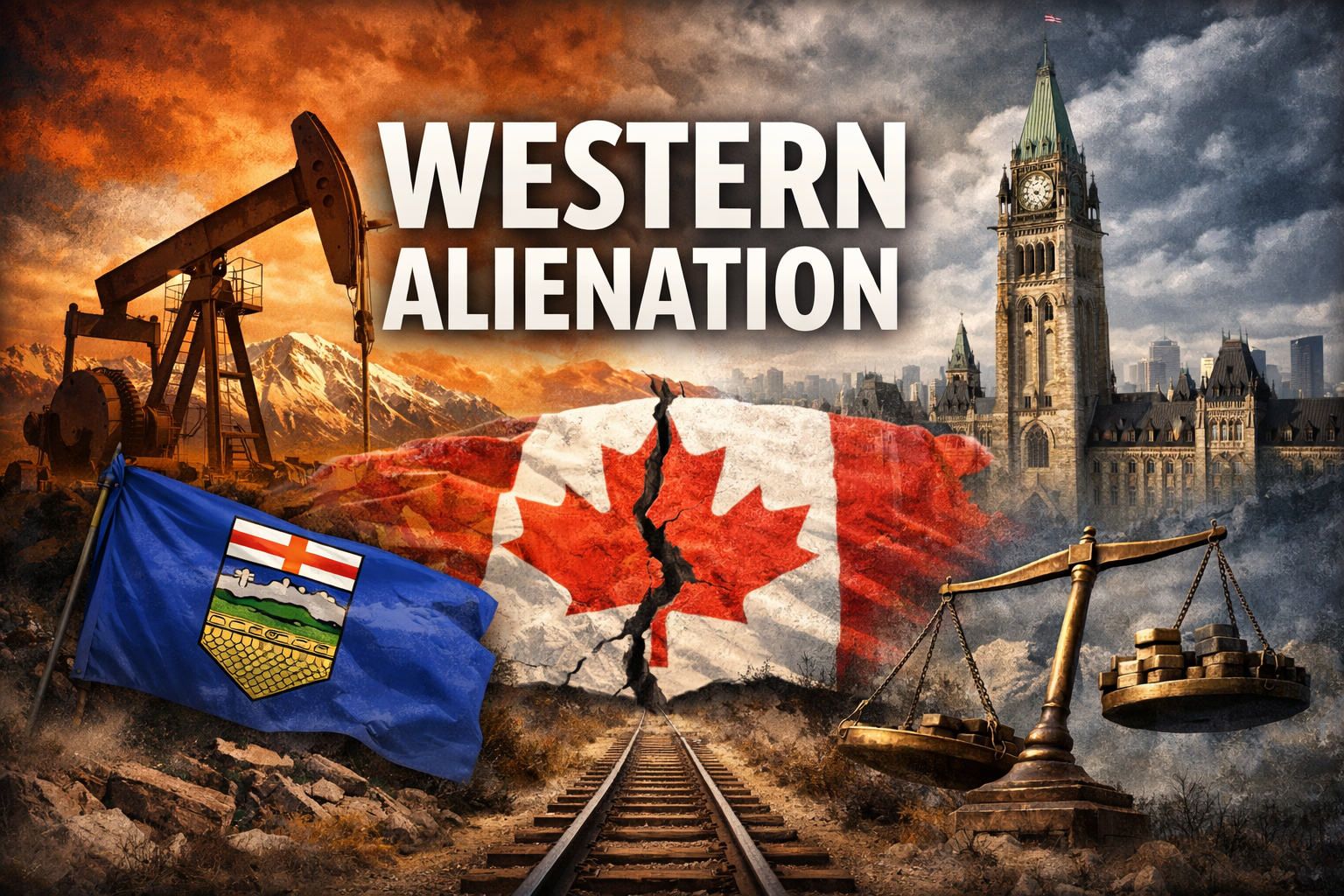
Table of Contents
-
Introduction: Why the Separation Debate Exists
-
What Is Western Alienation?
-
Confederation and the Eastern Power Structure
-
Representation in Parliament: A Structural Imbalance
-
Why Voting Power Feels Unequal
-
How This Fuels Modern Separation Sentiment
-
What It Means for Canada Going Forward
-
Sources & Further Reading
1. Introduction: Why the Separation Debate Exists
Discussions about Alberta separating from Canada do not emerge in a vacuum. They are rooted in a long-standing political and economic grievance known as Western alienation—a feeling that Western provinces, particularly Alberta and Saskatchewan, are not treated as equal partners within Confederation.
To understand why some Albertans even contemplate separation, it is necessary to look beyond present-day politics and examine the historical foundations of Canada’s political structure.
2. What Is Western Alienation?
Western alienation is a uniquely Canadian political term describing the perception in Western Canada that national institutions and policies are dominated by Central and Eastern Canada, often at the expense of Western interests.
It reflects:
-
Under-representation in political decision-making
-
Policy outcomes that appear to disadvantage resource-producing provinces
-
A belief that federal institutions were designed to preserve eastern political dominance
Reference:
https://www.thecanadianencyclopedia.ca/en/article/western-alienation
https://en.wikipedia.org/wiki/Western_alienation
3. Confederation and the Eastern Power Structure
When Canada was formed in 1867, it consisted of only four eastern provinces:
-
Ontario
-
Quebec
-
Nova Scotia
-
New Brunswick
Political power, economic institutions, and constitutional frameworks were created before the West had meaningful population or representation. As Western settlement expanded in the late 19th and early 20th centuries, the structure of the federation had already been shaped to reflect eastern priorities.
Reference:
https://www.thecanadianencyclopedia.ca/en/article/confederation
https://lop.parl.ca/sites/PublicWebsite/default/en_CA/ResearchPublications/201701E
4. Representation in Parliament: A Structural Imbalance
Today, the House of Commons contains 338 seats. However, representation is not strictly based on population. Constitutional guarantees protect smaller provinces from losing seats, resulting in significant variation in riding size.
Typical population per riding:
-
Atlantic Canada: ~60,000–75,000
-
Alberta & Saskatchewan: 100,000–120,000+
This means fewer voters are required to elect an MP in Eastern Canada than in Western Canada.
Reference:
https://www.elections.ca/content.aspx?section=res&dir=cir/red/343list&document=index&lang=e
https://lop.parl.ca/sites/PublicWebsite/default/en_CA/ResearchPublications/201807E
5. Why Voting Power Feels Unequal
Because of this structure:
-
An individual vote in Atlantic Canada can carry more weight than one in Alberta.
-
Western Canadians often perceive federal elections as being effectively decided before Western polls close.
-
Political influence appears concentrated in Ontario, Quebec, and Atlantic Canada.
While constitutionally legal, this imbalance contributes directly to the feeling that Western voices are diluted within national decision-making.
Reference:
Supreme Court of Canada – Reference re Provincial Electoral Boundaries (Sask.)
https://scc-csc.lexum.com/scc-csc/scc-csc/en/item/182/index.do
6. How This Fuels Modern Separation Sentiment
Western alienation is not only about representation. It interacts with:
-
Federal energy policy
-
Equalization payments
-
Environmental regulation
-
National economic planning
But democratic imbalance is one of the most emotionally resonant issues because it strikes at the core principle of political equality: one person, one vote.
This perception has helped fuel:
-
Reform Party movement (1990s)
-
Wexit movement (2019–2021)
-
Alberta Sovereignty debates
-
Calls for Senate reform
-
Periodic separation discussions
Reference:
https://www.irpp.org/research-studies/the-persistence-of-western-alienation/
https://www.thecanadianencyclopedia.ca/en/article/reform-party-of-canada
7. What It Means for Canada Going Forward
Western alienation does not automatically lead to separation. But it does signal a structural tension within the federation:
-
A fast-growing West with less proportional political influence
-
An aging East protected by constitutional seat guarantees
-
A national policy framework increasingly shaped by central Canada
If left unaddressed, this imbalance risks deepening regional polarization and weakening national cohesion.
The question is not only whether Alberta should separate—but whether Canada’s federal system can evolve enough to ensure all regions feel equally represented within it.
8. Sources & Further Reading
Western Alienation Overview
https://www.thecanadianencyclopedia.ca/en/article/western-alienation
https://en.wikipedia.org/wiki/Western_alienation
Parliamentary Representation
https://www.elections.ca
https://lop.parl.ca
Supreme Court Ruling on Representation
https://scc-csc.lexum.com
Historical Federalism
https://www.irpp.org
https://www.thecanadianencyclopedia.ca
