
What Industry Insiders Are Seeing — And Why No One Wants to Say It
Table of Contents
What Industry Insiders Are Seeing
We didn’t talk to pundits.
We didn’t talk to people guessing.
We spoke directly to brokers, mortgage professionals, and real estate lawyers — the people who see real transactions every day, and were willing to share it.
And what they’re seeing isn’t “concerning.”
It’s f*ing disturbing — and almost nobody wants to say it out loud.
So let’s ask the question everyone keeps dodging:
What the hell is actually happening in the GTA condo market?
Why “Staying in Our Lane” Misses the Point
People keep telling us to “stay in our lane.”
Stick to recruiting.
Stick to employment.
Stick to job postings.
Here’s the problem with that thinking:
Employment does not exist in a vacuum.
There is one thing that drives hiring before anything else — business and consumer confidence.
And right now, consumer confidence in Canada is being crushed in real time, as tracked by the Canadian Index of Consumer Confidence, a recognized leading economic indicator:
👉 https://en.wikipedia.org/wiki/Canadian_Index_of_Consumer_Confidence
Real Estate Isn’t a Side Story — It Is the Economy
Let’s get one fact straight, because this is where people seriously underestimate what’s coming:
Roughly 13% of Canada’s entire economy is directly tied to real estate, including real estate, rental, and leasing activities — one of the largest contributors to national GDP:
👉 https://en.wikipedia.org/wiki/Economy_of_Canada
That includes:
-
Real estate transactions
-
New construction and condo development
-
Mortgage lending
-
Renovations
-
Legal, financial, and professional services
-
Investor activity
-
Consumer spending fueled by home equity
When real estate stalls, everything connected to it stalls.
And when it collapses?
The damage spreads everywhere.
The GTA Condo Market Is Being Slaughtered
Toronto Condo Meltdown: What’s Really Going On and How Did We Get Here?
Let’s stop using polite language.
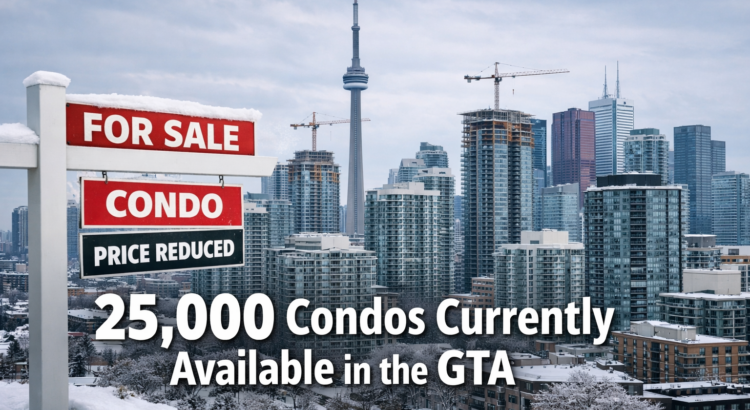
The GTA condo market is being slaughtered.
Market data and independent real estate analysis show active condo listings surging while sales volumes collapse, a classic sign of an oversupplied market:
👉 https://www.movesmartly.com/articles/gta-housing-2025-a-year-that-turned-on-a-dime
Right now:
-
Tens of thousands of condo units are sitting available across the GTA
-
Sales activity has fallen to historic lows
-
Months of inventory have blown out well beyond balanced-market levels
According to CREA and TREB market condition data, months of inventory for GTA condos have reached levels that historically signal price pressure and market stress, not stability:
👉 https://creastats.crea.ca/mls/treb-market-conditions/
That’s not a slowdown.
That’s not a pause.
That’s a dead market.
Prices haven’t fully collapsed yet — but sales already have.
And that’s how every real crash starts.
This Isn’t 2008 — This Is the 1990s All Over Again
Everyone wants to believe this is another 2008 scenario:
Sharp drop. Quick rebound.
It’s not.
This looks far more like the early 1990s Canadian housing correction, when prices fell deeply and recoveries took years — not months.
During that period:
-
Real estate values dropped 40–50%+ in some markets
-
Job security eroded slowly, then suddenly
-
Entire career paths stalled
Today’s conditions — oversupply, high household debt, tightening credit, and collapsing transaction volume — mirror that environment far more than 2008.
This is a long, grinding reset, not a one-day crash.
And that’s worse.
Why This Matters for Jobs
When real estate dries up — and it already has — here’s what follows:
-
Developers stop building
-
Investors stop buying
-
Lenders tighten credit
-
Small businesses lose customers
-
Hiring freezes spread
-
Layoffs start quietly, then publicly
This sequence is not theoretical. It’s observable in every housing-led slowdown.
The job market always lags real estate. Always.
What you’re seeing in housing right now is the early warning system for employment.
We haven’t even begun to see how bad this gets.
If You Have a Job — Hold Onto It
Here’s the blunt truth people don’t like hearing:
-
If you have a job: protect it
-
If you don’t have a job: get aggressive immediately
Because in a recession:
-
Fewer jobs get posted
-
Competition explodes
-
Employers get pickier
-
Hiring slows long before headlines admit it
The opportunities that exist today will not be easier to find tomorrow.
What Job Seekers Should Be Doing — Now
Not later.
Not “when things pick up.”
Now.
-
Polish your resume
-
Update your LinkedIn
-
Start networking before you need to
-
Build real connections — not surface-level ones
-
Be proactive, not reactive
Waiting for conditions to improve is how people get left behind.
Governments Can’t Hire Their Way Out of This
Yes, governments can:
-
Print money
-
Increase public hiring
-
Run deficits
-
Prop up short-term demand
But that only works temporarily.
Real job creation comes from the private sector:
-
Small businesses
-
Medium-sized businesses
-
Entrepreneurs
When real estate collapses, consumer spending collapses — and private hiring follows.
You cannot stimulus your way out of a confidence collapse forever.
The Condo Inventory Problem No One Wants to Admit
Behind closed doors, the same reality keeps coming up:
There are tens of thousands of unsold condos sitting in the GTA.
Independent reporting and data analysis confirm historic oversupply in Toronto-area condo markets, with inventory far exceeding demand:
👉 https://thehub.ca/2025/05/17/chart-storm-five-graphs-on-torontos-historic-condo-market-collapse/
Public stats argue over definitions.
They get cute about what “available” really means.
It doesn’t matter.
Every serious data source shows the same thing:
-
Supply has exploded
-
Sales have collapsed
-
Months of inventory are blowing out
That’s not opinion.
That’s what an oversupplied market looks like right before prices crack.
This Is a Frozen Market — Not a Functional One
In multiple GTA sub-markets, insiders tracking real listings and real closings are seeing inventory levels completely detached from sales activity.
At the same time, new home and condo sales have fallen to record lows, according to independent housing research:
👉 https://betterdwelling.com/toronto-new-home-sales-crash-72-to-a-record-low/
When insiders say:
“Only a few dozen condos are actually selling,”
That’s not exaggeration.
That’s what happens when demand disappears and supply keeps piling up.
Why No One Wants to Talk About This
Watch mainstream housing coverage.
They talk about:
-
Average prices
-
Detached homes
-
Interest rate guesses
-
“Spring rebound” stories
What they don’t talk about:
-
Condo oversupply
-
Assignment sales
-
Investor-heavy buildings
-
Sales versus listings
-
Absorption rates
-
Inventory sitting month after month
Because that conversation gets uncomfortable fast.
And it breaks the narrative.
Assignment Sales: The Hidden Market Dragging Everything Down
Assignment sales are the resale of a pre-construction condo contract (APS), typically marketed privately because builders prohibit MLS advertising. This restriction skews the market. If a unit can’t be publicly advertised, it doesn’t show up in official inventory counts, sales data, or market statistics.
That’s the hidden market — and it’s the real problem.
Thousands of assignment units are sitting off-market, invisible to the public but very real to the people stuck holding them. These assignments are coming due, and in many cases, buyers can’t close. Financing no longer works, appraisals are short, and carrying costs are brutal. As a result, purchasers are walking away from their commitments.
But the units don’t disappear.
They remain trapped in the private market, quietly dragging down prices, confidence, and liquidity across the entire condo sector. This shadow inventory is the anchor pulling the condo market — and related real estate transactions — into a full-blown crash.
Final Reality Check
The condo market isn’t just a housing story.
It’s a leading economic indicator — and it’s screaming.
This isn’t fear-mongering.
This isn’t politics.
This isn’t hype.
It’s math, history, and data colliding.
We are either already in a recession — or standing right on the edge of one.
Pretending otherwise doesn’t protect jobs.
Preparing does.
Continue Reading: Part 2 — Job Seeker Action Checklist
👉 Part 2 of the GTA Condo Market Crisis:
Job Seeker Action Checklist — Do This Now, Not Later
This article explains what’s happening.
Part 2 breaks down exactly what job seekers need to do next — step by step, immediately.
Written by: Taylor Lane, a freelance writer for Hot Job Ads Inc.
About the Author: Taylor Lane is a freelance writer for Hot Job Ads Inc., specializing in employment trends, recruitment insights, and job search strategies across Canada and the U.S. Passionate about connecting people with meaningful work, Taylor helps job seekers and employers navigate the modern hiring landscape.
